
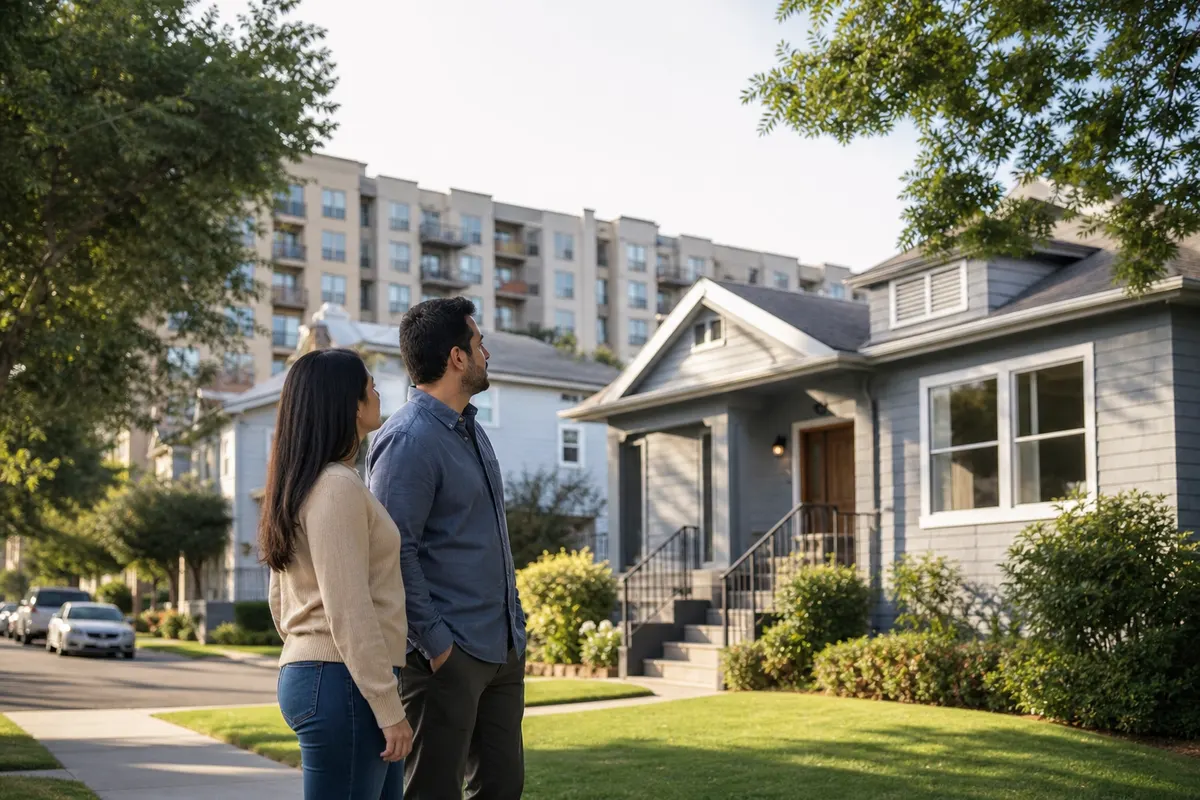
Should you buy a house or keep renting?
Buying usually makes sense when you plan to stay at least five years, have the down payment and closing costs saved without touching your emergency fund, have no high-interest debt, and the full monthly cost of owning fits your budget with room to keep saving. If any of those is missing, renting a while longer is often the stronger choice.
Renting is not throwing money away. Rent buys you a place to live, plus flexibility and someone else paying for the new roof. A mortgage payment also includes a lot of interest, especially in the early years. The question isn't which one is better in general. It's which one fits your life and your numbers right now.
This guide is general education, not personalized financial, tax or legal advice.
The monthly costs beyond the mortgage
When people compare rent with a mortgage, they often compare rent with principal and interest only. But owning has more monthly costs. Property taxes. Homeowners insurance, which usually costs more than renter's insurance. Private mortgage insurance, often called PMI, if you put down less than 20% on a conventional loan. HOA fees in many condos and planned communities.
Then there is upkeep. A common rule of thumb is to plan 1% to 2% of the home's value each year for maintenance and repairs, more for older homes. Some years you spend little. Other years the water heater, the roof or the air conditioner all want attention at once.
Utilities often rise too, because houses are usually larger than apartments, and some costs your landlord used to cover, like water, trash or lawn care, become yours.
A side-by-side example
Here is an example with stated assumptions. A couple pays $1,700 a month in rent plus $20 for renter's insurance, so $1,720 in total. They are looking at a $300,000 home with 10% down, $30,000, and a $270,000 30-year fixed mortgage at an assumed 6.5% rate.
Principal and interest come to about $1,707 a month. Add property taxes at an assumed 1.2% a year, $300 a month; homeowners insurance at $150; PMI at an assumed $110; and maintenance at 1% of the home's value, $250. The full monthly cost is about $2,517, roughly $800 a month more than renting. You can run your own version with the mortgage calculator.
Not all of that is a cost, though. Part of each payment builds equity. But early on, it's a small part: in the first year, about $3,000 of the roughly $20,500 in mortgage payments goes to principal. The rest is interest.
Before you compare, check the rent side honestly too. If your rent is already a stretch, the steps in how much rent you can really afford apply to a mortgage payment as well.
The up-front costs people forget
The down payment is only the start. Closing costs, which include lender fees, title, appraisal and prepaid taxes and insurance, are commonly cited at 2% to 5% of the loan amount. In the example, 3% of $270,000 is about $8,100.
Then come moving, basic furniture for extra rooms, window coverings, tools, a lawn mower and the small repairs you find in the first months. Plan at least $2,000 for these in a smaller home. In the example, the couple needs about $40,100 in cash: $30,000 down, $8,100 in closing costs and $2,000 for moving and setup.
Their emergency fund has to stay whole on top of that. As homeowners, many people aim for the higher end of 3 to 6 months of essential expenses, because there is no landlord to call when the furnace stops.
Selling has costs too. Agent commissions and closing costs when you sell can take a noticeable share of the sale price. That's a big reason short stays often favor renting: a few years may not be long enough for rising value and paid-down principal to cover the costs of buying and selling.
Signs you are ready to buy
You expect to stay in the area for at least five years. Your job or income is fairly steady. You have no high-interest debt, and your full emergency fund is in place. You've saved the down payment, closing costs and setup costs as a separate goal. And the full monthly cost, not just the mortgage, fits your budget while you keep investing for retirement.
That order matters. In the Hoarding Wealth method, a down payment is a goal you save for after high-interest debt is gone and the emergency fund is full, while your regular retirement investing continues. If you're still building those, see what to do after your emergency fund for how the later stages fit together.
If some signs are missing, that is not a failure. Renting while you finish the foundation keeps your options open. Some people also find that moving to a cheaper area changes the math for both renting and buying.
Steps you can take this week
Write down your full current housing cost: rent, renter's insurance, utilities and parking. That's the number to compare against.
Pick one realistic home in your area and estimate its full monthly cost: principal and interest, property taxes, insurance, PMI if needed, HOA fees and maintenance. Then estimate the up-front cash. Ask a lender for a loan estimate if you're getting close; the CFPB has free guides that explain each line on it.
Compare the two in your budget. If the owning cost would stop your saving or push you back into debt, keep renting for now, and turn the down payment into a monthly savings goal. You can lay out both options with real numbers before you decide.
Using Hoarding Wealth to make the decision
In Hoarding Wealth, you can create a goal for the down payment and add a monthly line for it in your zero-based Budget. On the free plan you have one goal; Premium adds unlimited goals with AI projections and Savings Vaults to keep the house money apart from your emergency fund.
The Wealth Path shows which stage you are in. If you are still clearing debt or building the emergency fund, it keeps your next step clear, so the house goal doesn't jump the line. Wealth Coach can walk you through the trade-offs or help you list questions for a lender. You type your own numbers; the app never connects to your bank or moves money.
Paying off a home early is one of the bigger goals in the final Wealth stage. If that is where you are headed, the page on building wealth step by step shows how the stages lead there.
Frequently asked questions
Is it better to rent or buy a house?
It depends on how long you'll stay, your savings and your monthly budget. Buying often makes more sense for stays of five years or more, once high-interest debt is gone and your emergency fund is full.
How much should I save before buying a house?
Plan for the down payment, closing costs commonly cited at 2% to 5% of the loan, and moving and setup costs, while keeping your full emergency fund untouched.
Is renting throwing money away?
No. Rent pays for housing and flexibility, much like the interest, taxes and insurance that make up a large part of an owner's monthly cost.
How much does home maintenance cost per year?
A common rule of thumb is 1% to 2% of the home's value each year, more for older homes. Actual costs vary a lot from year to year.