
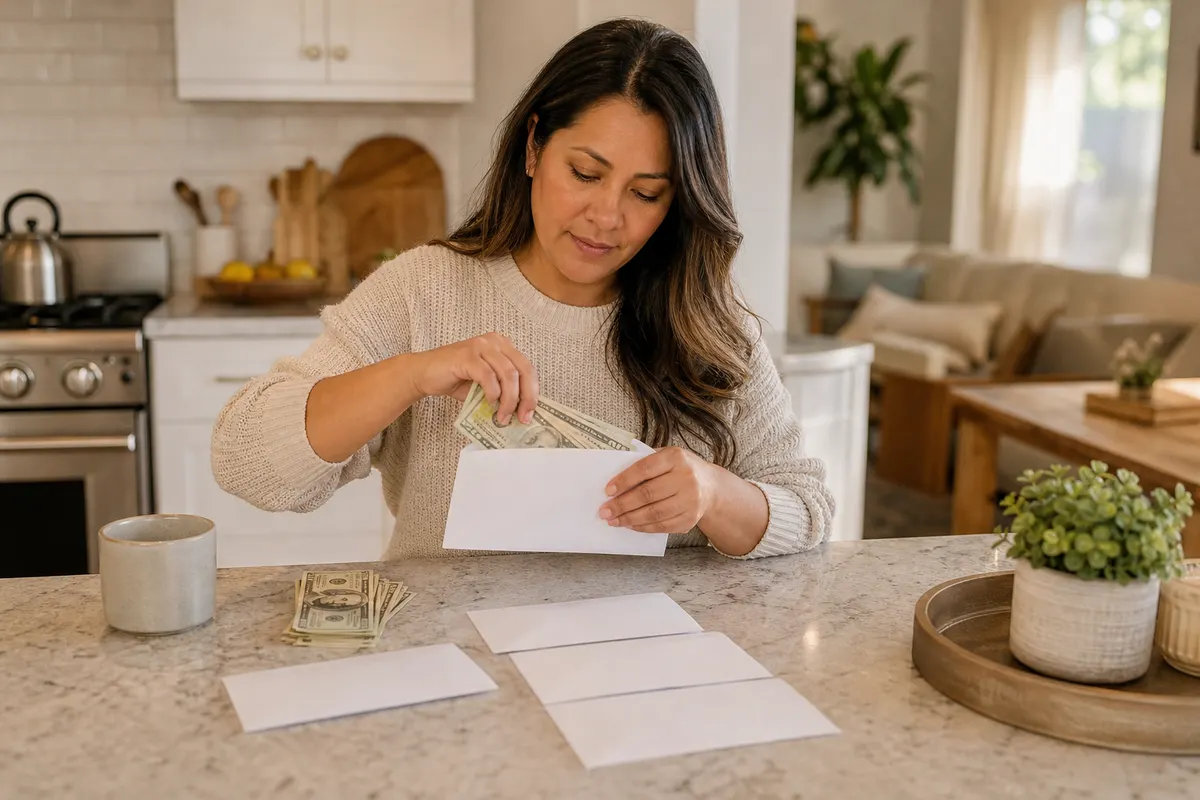
How do you start an envelope budget?
To start an envelope budget, plan your month first, then choose the few spending categories that tend to run over, like groceries, gas and eating out, and give each one an envelope with a set amount every payday. When an envelope is empty, spending in that category stops until the next refill or until you move money from another envelope on purpose.
That is the whole method. It works because you can see, and feel, how much is left. You don’t need special software or a perfect plan to begin. You need a list of categories, an amount for each, and a payday to start on.
If you are still deciding whether envelopes are right for you at all, our comparison of envelope budgeting and zero-based budgeting explains how the two fit together. This guide assumes you have decided to try it and shows you how to set it up.
Step 1: Decide which categories get an envelope
Not every bill belongs in an envelope. Rent, utilities, insurance, the car payment, debt minimums and your savings transfer are fixed and usually paid by bank transfer or autopay. Leave them in checking and pay them on time.
Envelopes are for the flexible categories, the ones where small purchases add up without you noticing. For most people that means groceries, gas, eating out, household supplies, kids’ costs and personal spending. Some people add clothing, gifts or a pet envelope.
Start with four to six envelopes. More than that becomes hard to manage, especially in the first month. You can always add one later once the habit sticks.
Step 2: Choose cash or digital envelopes
Cash envelopes are the classic version. You withdraw the total on payday, split it into labeled envelopes, and pay with that cash. Handing over bills makes spending feel real, which is why cash helps so many people who overspend with a card.
Digital envelopes give you the same limits without carrying cash. Some banks let you create separate savings buckets or sub-accounts. Others keep one checking account and use a budget that tracks how much is left in each category. You spend with a debit card, write down each purchase, and treat the remaining amount as the money in the envelope.
Many people mix both: cash for groceries and eating out, where overspending happens most, and digital tracking for gas and online purchases. Choose the version you will actually keep up with. The best envelope is the one you check.
Step 3: Fill the envelopes every payday
Here is an example with made-up but realistic numbers. Luis is a single dad who takes home $1,600 every other Friday. His rent, utilities, phone, insurance, car payment, card minimum and savings transfer are all paid from checking. What is left for flexible spending is $510 per paycheck.
He splits it into six envelopes each payday: groceries $260, gas $90, eating out $50, household $30, kids $40 and personal $40. That is $510 every two weeks, or $1,020 in a month with two paychecks. Because he refills by paycheck, each envelope only has to last 14 days, not a whole month.
If you get paid twice a month, divide each monthly category in half. If you are paid weekly, divide by four, and in months with five paydays decide ahead of time whether the fifth paycheck refills the envelopes or goes to your current goal. If your income changes, fill the envelopes from your lowest likely paycheck and treat extra money as a bonus to give a job later.
Refill on the same day each time. When envelopes are filled on payday, before anything else is spent, they never compete with leftovers.
Step 4: Know what to do when an envelope runs out
It will happen, especially in the first month. On day 11, Luis’s grocery envelope is empty and he still has $25 in eating out. He moves that $25 to groceries. Moving money between envelopes is allowed, as long as you decide it on purpose and it comes from another flexible envelope.
Three things are not allowed. Don’t borrow from rent or bill money, don’t raid your savings, and don’t reach for the credit card. Those moves turn a small overspend into a bigger problem next week. If every envelope is empty, the honest answer is to wait until payday and use what is already in the pantry or the tank.
When an envelope runs out often, the amount is probably too low. Raise it at the next planning session and lower another one. If you keep running out of money before payday across the board, the problem is the whole plan, not one envelope.
Money left over at the end of a pay period is good news. You can roll it forward into the same envelope or move it to your current goal, such as your starter buffer or extra debt payments. Decide which in advance so the leftover doesn’t quietly become spending.
Keeping cash envelopes safe
Cash can be lost or stolen, and unlike money in a bank, it is not FDIC insured. Carry only the envelopes you need that day, such as groceries on shopping day, and keep the rest at home in one safe place that others in the house don’t pass through.
Keep only one pay period of spending money in cash. Your starter buffer and emergency fund do not belong in an envelope at home; they belong in an insured savings account, as explained in our guide to the safest place for an emergency fund.
Some purchases are easier by card, like gas at the pump or online orders. That is fine. Pay with a debit card, then take that amount out of the envelope and move it back to checking, or simply note it in your tracking so the envelope total stays honest.
Your first week with envelopes
Look at last month’s spending and pick four to six flexible categories that ran over.
Set an amount for each based on what you actually spent, trimmed a little where you can. Make sure your whole plan still balances, with bills and savings covered first.
Label envelopes or create digital categories, and fill them on your next payday.
At the end of the first pay period, write down what ran out and what was left, and adjust the amounts for the next one.
Digital envelopes in Hoarding Wealth
In Hoarding Wealth, each line in your zero-based Budget works like a digital envelope. The Planned amount is what goes in, the Actual amount is what you have spent, and the difference is what is left. You record purchases and close the month so you can see which envelopes held and which need a new amount next time. The app never connects to your bank or moves money; you type your numbers, which keeps the envelope feeling as real as cash.
The free plan includes the Budget for the current month with one income source, budget notices and Wealth Coach to help you set your first amounts. If your money feels scattered and you want a simple system that sticks, start getting ahead here.
Not sure which envelopes you will struggle with? The free Money Personality assessment shows your spending patterns in a few minutes, so you know where to start.
Frequently asked questions
What categories should be in an envelope budget?
Flexible categories that tend to run over, such as groceries, gas, eating out, household supplies, kids’ costs and personal spending. Fixed bills like rent and insurance are better paid from checking.
How much cash should I keep in envelopes?
Only one pay period of flexible spending. Savings and your emergency fund belong in an insured bank account, not at home.
What happens when an envelope runs out?
You stop spending in that category or move money from another flexible envelope on purpose. Don’t borrow from bills, savings or a credit card.
Can you do envelope budgeting without cash?
Yes. Digital envelopes use separate bank buckets or a budget that tracks what is left in each category while you pay by debit card.