Wealth Path
Your stage and its steps are free. Premium adds a Wealth Path written by AI from your own numbers.

Hoarding Wealth is a budgeting and personal finance learning app that helps people who want to build wealth but don't know where to start by placing them on a six-stage Wealth Path and showing the one next step for the stage they are in. It is built for people who are the first in their family to budget, save or invest.
Start freeBuilding wealth is less about picking the right investment and more about doing things in the right order. The Hoarding Wealth Wealth Path has six stages, and you work through them one at a time:
If nobody in your family invested, money advice can sound like a language you were never taught. Social media says one thing, a coworker another, a relative says the market is gambling.
So people often start in the wrong place. They invest a little while a credit card charges them far more in interest than the investment is likely to earn, or they skip the emergency fund and have to sell when the car breaks down.
Take the free Money Personality assessment, pick the goal that matters most, such as buying your first home or retiring comfortably, and plan your first month.
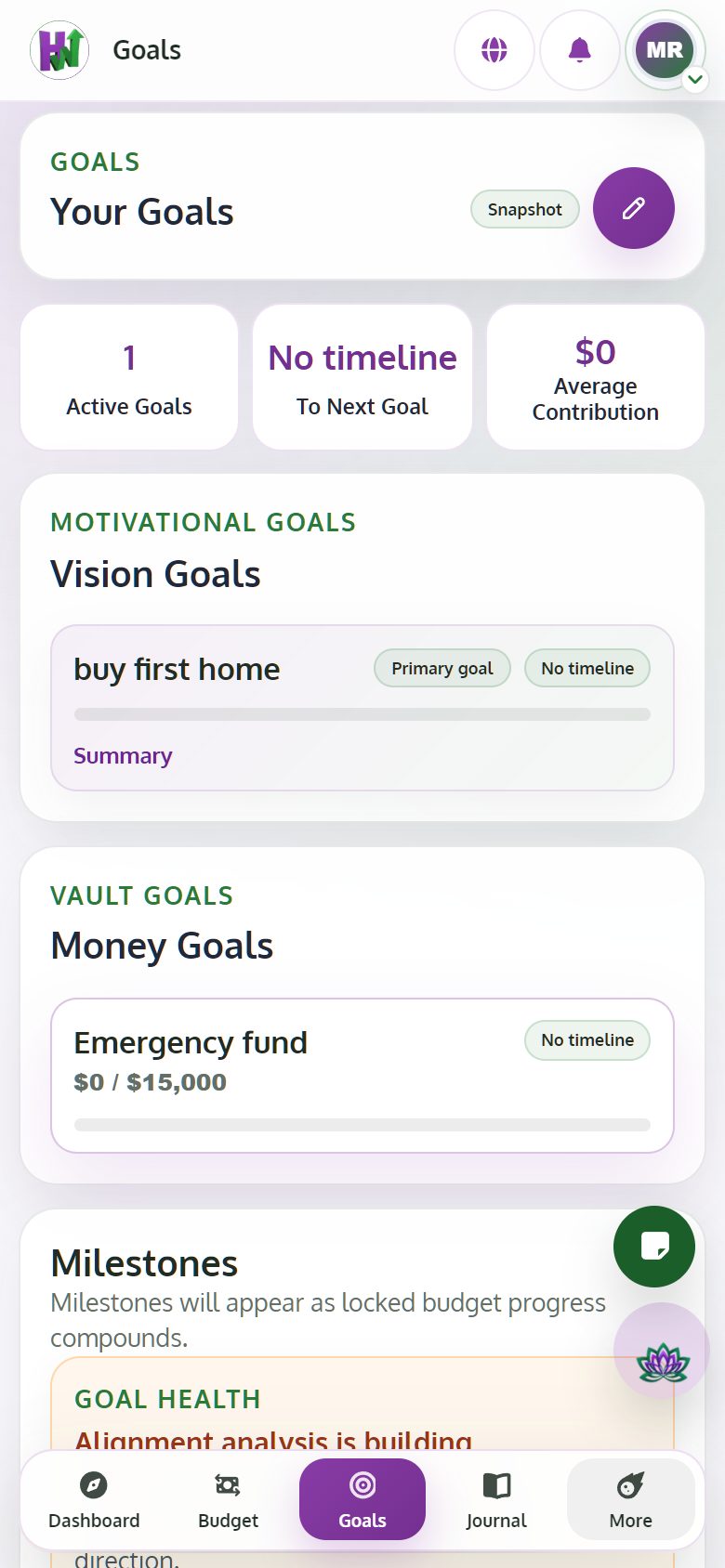
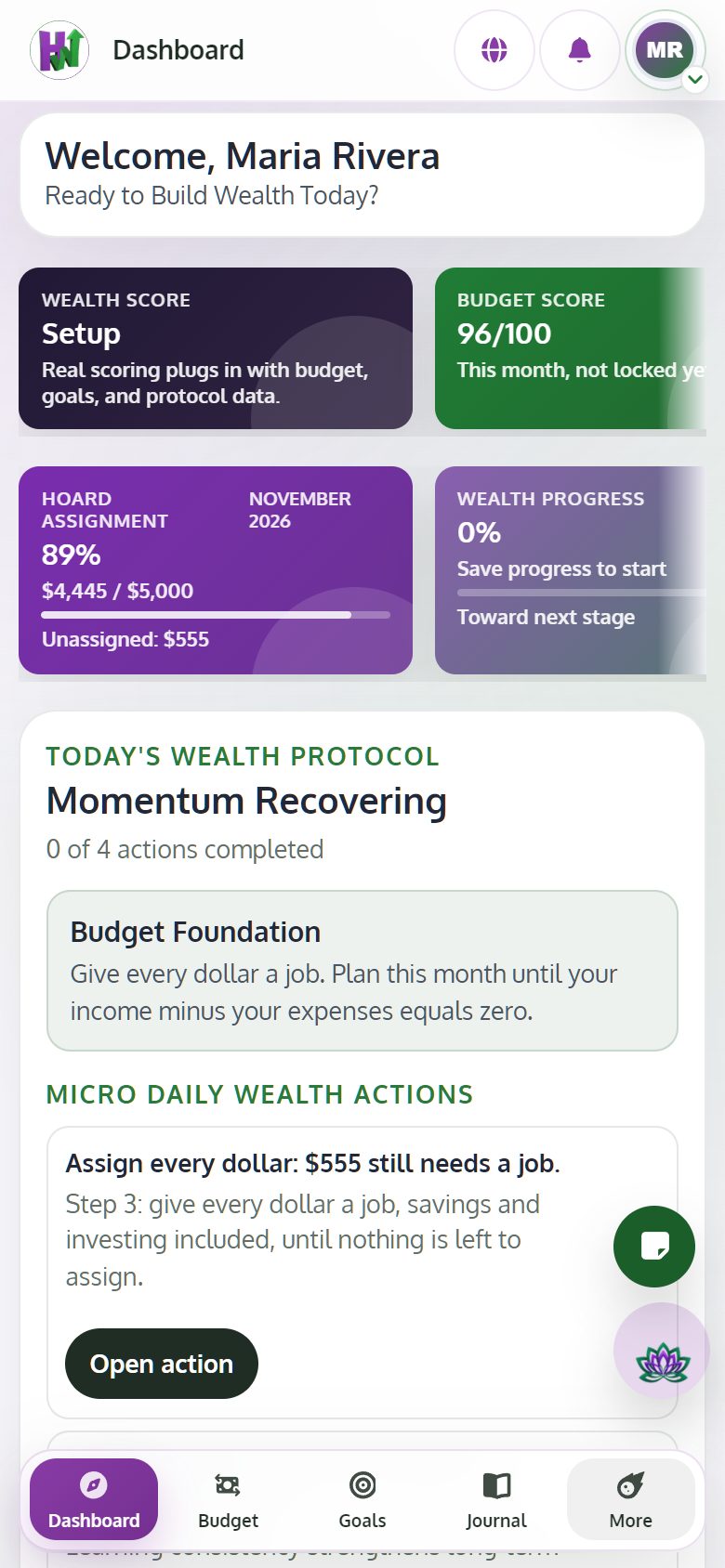
Your stage isn't a quiz answer. It comes from the months you close in your budget: if your latest closed month has money in the Debt category, you are in Debt; if your emergency savings are under three months of essential expenses, you are in Emergency; and so on. The Dashboard shows the next step for that stage.
Why: Your own numbers decide the stage, so the advice fits where you really are.
In the Debt stage, the step is the Emergency Buffer, then extra payments to the highest-interest debt. In the Emergency stage, it is the three-month fund. The one exception to the order: if your employer matches retirement contributions, take the match even before investing is your stage.
Once Budget, Debt and Emergency are done, Prosperity Pursuit opens. Five questions describe you as an investor: time horizon, comfort with risk, how involved you want to be, whether you have an advisor and how confident you feel. You get a card to prepare for an advisor meeting and a Financial Team guide with green flags, red flags and questions to ask.
Here is an example. Someone takes home $4,000 a month. The app estimates essential expenses as the larger of $2,000 or 60% of income. Sixty percent of $4,000 is $2,400, which is more than $2,000, so the estimate is $2,400.
Their Emergency Buffer target is $2,000. Three months of essential expenses is $7,200, the amount the Emergency stage needs; six months, a full fund, is $14,400. With the $2,000 buffer already saved and $400 a month going to the fund, they reach $7,200 in 13 months.
Your stage and its steps are free. Premium adds a Wealth Path written by AI from your own numbers.
Investor profile, advisor preparation, retirement vault alignment and a Financial Team guide. Free, and it opens at the Investing stage.
Short lessons for each stage, with a quiz, reflection questions and one step to apply. Every lesson is free.
Savings, emergency fund, retirement, nest egg and retirement age, free on the site and in the app.
Explains your plan and suggests one action at a time. It won't push aggressive investing while you are in the Debt or Emergency stage.
Hoarding Wealth teaches and you decide. It doesn't recommend specific investments, open accounts, hold your money or move it. When you reach Investing, Prosperity Pursuit shows an illustration of your balance growing at 7% a year over 5, 10 and 15 years. That is an illustration, not a forecast; real returns go up and down.
Prosperity Pursuit stays closed until you finish Budget, Debt and Emergency. That is the point: the order keeps invested money from being pulled out for an emergency or eaten by card interest.
If you already have no bad debt and a full emergency fund, and you want to pick stocks, trade or track a portfolio, a brokerage or portfolio tracker is the right tool.
Knowing where you are and planning one month. In Hoarding Wealth that is the Snapshot stage: you take the Money Personality assessment, set a goal and plan your first budget. Investing comes later, after bad debt is gone and the emergency fund is built.
Pay off bad debt first, after building a small Emergency Buffer. The one exception is an employer retirement match, which most people should take even while paying down debt, because it is money they would otherwise lose.
Three to six months of essential expenses. Hoarding Wealth moves you to the Investing stage once you have at least three months saved.
No. The app teaches how investing works, helps you describe yourself as an investor and prepares you to talk to an advisor, but it never tells you to buy a specific investment.
No. The Wealth Path is the same on any income. A smaller income makes each stage take longer, not a different order.
Short lessons tied to your own budget, so you learn money by using it, one stage at a time.
See how it helpsHourly, salary, gig or a small paycheck: the same order works, and the targets scale to what you earn.
See how it helpsA small cushion first, no new charges, then every extra dollar to the highest-interest card, with a tracker that shows your pace.
See how it helpsTake the free Money Personality assessment, plan your first month and see your next step.
Start free