Zero-based budget
One income source is included in the free plan, which fits most one-earner homes. Month, week, timeline and calendar views.

Hoarding Wealth is a budgeting and personal finance learning app that helps families living on one income make that paycheck cover the whole household by planning every dollar before the month starts and building their safety net in a clear order. It works for a parent at home, a single parent or any home with one earner.
Start freeLiving on one income is often a choice made on purpose: a parent stays home with young kids, or cares for a relative. Sometimes it isn't a choice at all, like after a divorce or a job loss. Either way, the math is the same. Every bill, every grocery run and every birthday comes out of one paycheck.
The hard part is not that one income can't work. It is that there is no second paycheck to catch you. If the car breaks down or the earner gets sick, there is nothing in the background covering the gap. Without a plan, those months land on a credit card.
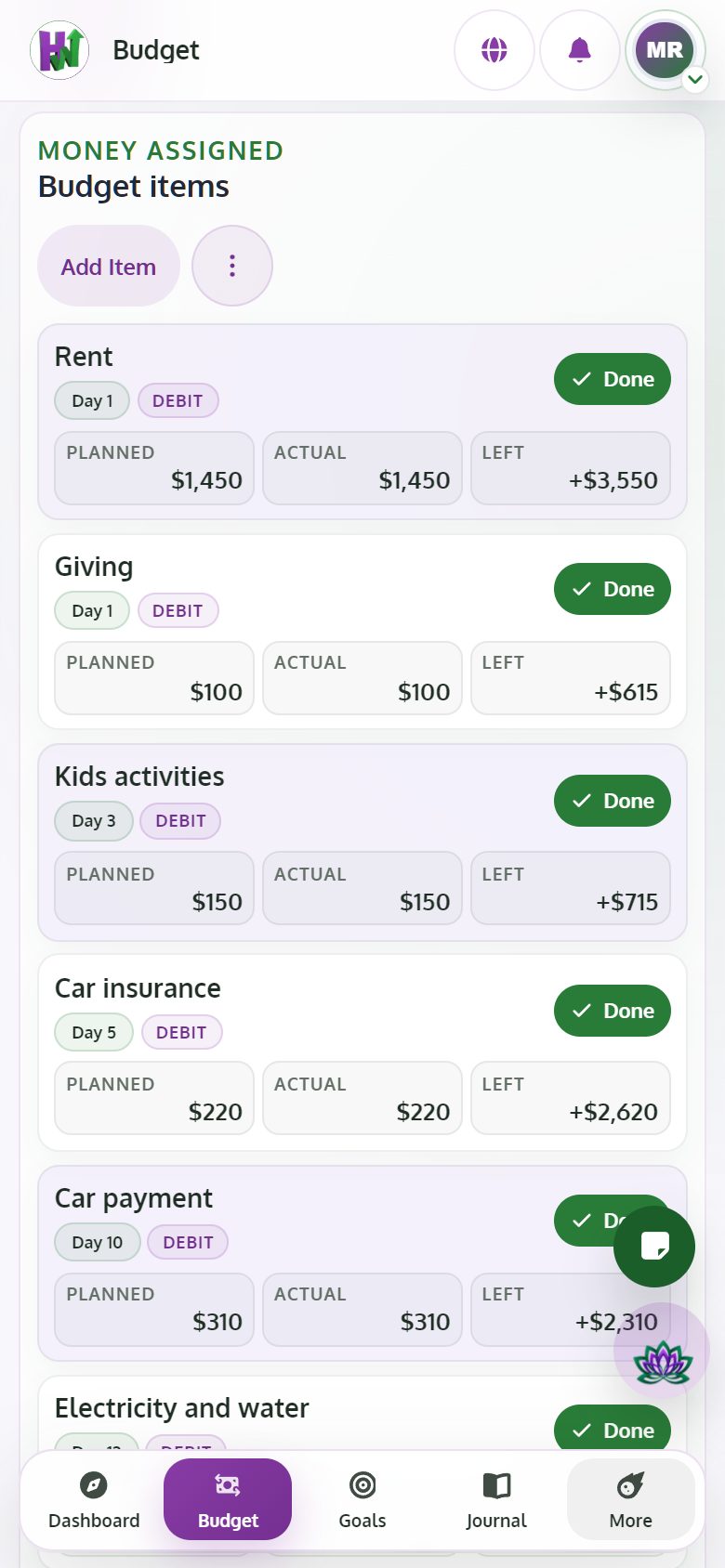
In a zero-based budget, the paycheck is planned down to the last dollar: housing, food, the kids, transportation, savings and a little fun money. Each line has a Planned and an Actual amount, so you see right away when a category runs over.
Why: With one income there is less room for surprises, so the plan has to be complete.
The parent at home often handles most of the daily spending. With Premium, the earner can create a household and invite their partner, and both see and edit the same budget, goals and Savings Vaults. The invited partner joins for free.
Your Wealth Path places the family in one stage at a time. If you carry debt, you first build an Emergency Buffer of about $2,000 so a surprise doesn't turn into new debt, then send every extra dollar to the debt with the highest interest. After that comes the emergency fund: at least three months of essential expenses, and with one income, many families aim for the full six.
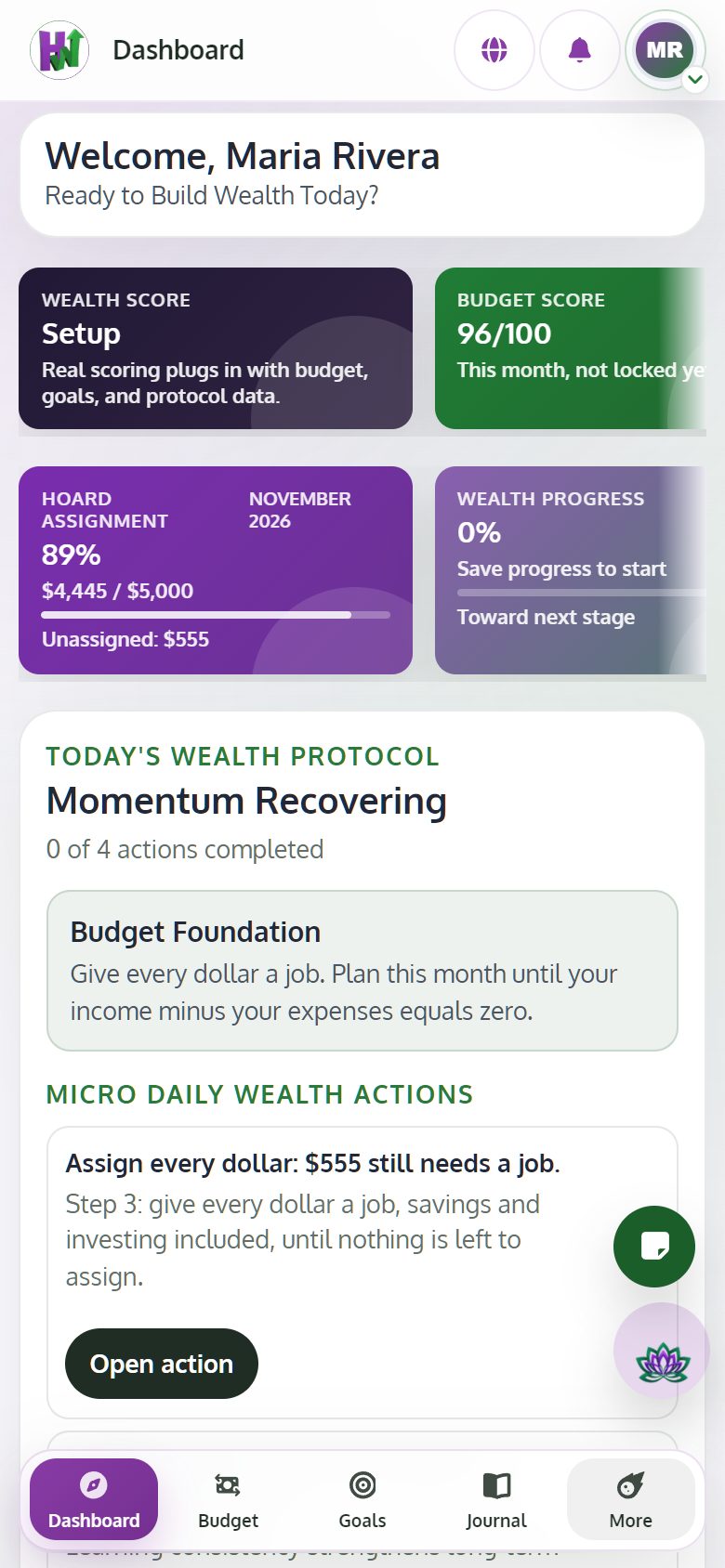
When every line has its Actual amount and is marked done, the month closes. Closed months set your stage, and the free Wealth Journey shows how your money and habits change month to month.
Here is an example with made-up numbers. A family of four lives on one take-home income of $4,800 a month. They have no credit card debt and already have $2,000 saved.
Their essential expenses are $3,500: housing $1,500, groceries $800, transportation $350, utilities $250, children's costs $250, insurance $200 and phone and internet $150. The other $1,300 goes to $500 for the emergency fund, $250 for family fun, $250 for car repairs and holidays, $150 for kids' activities and $150 of personal money ($75 for each adult). That adds up to exactly $4,800.
Three months of essentials is $10,500, so at $500 a month they reach it in 17 months. Six months is $21,000, which takes 38 months from where they started. If one month is tight, they lower the savings line instead of borrowing, and pick it back up the next. The Wealth Path uses its own rough estimate of essentials, the larger of $2,000 or 60% of income ($2,880 here), so its target can be lower than the family's real number; plan on the real one.
One income source is included in the free plan, which fits most one-earner homes. Month, week, timeline and calendar views.
One stage at a time, so the family knows whether the next dollar goes to the buffer, to debt or to the emergency fund.
Enter your essential expenses and what you can save, and see your target and how many months it takes.
Both adults plan the same budget, goals and vaults, each with their own login.
Ask a question like "What if our income increases?" and get a short estimate with charts, based on your closed months.
Hoarding Wealth doesn't connect to your bank and never moves money. You type your own numbers. The free plan covers one income source and the current month. If you have more than one source, such as a paycheck plus child support or a small side job, Premium lets you add each one.
The app doesn't sell or compare insurance. With one earner, life and disability insurance matter, and the reading guides below explain the basics, but choosing a policy is a conversation for a licensed professional. "Protect my family" is one of the goals you can pick, and the Wealth Coach can help you think it through.
If you want every transaction imported from your bank automatically, or you need to run a family business's books, a different tool will fit better.
Yes, many do. It works best when every dollar is planned before the month starts, debt for wants is avoided and the family builds a bigger emergency fund, because there is no second paycheck to fall back on.
At least three months of essential expenses, and many one-income families aim for six. Hoarding Wealth moves you past the Emergency stage at three months; six months counts as a full fund.
Often, yes. The free plan includes a full zero-based budget with one income source, the Wealth Path, the Total Debt Tracker, every lesson and the calculators. Premium adds more income sources, planning months ahead and a shared household.
Yes. Everything works for one adult on their own. You plan your paycheck, follow your Wealth Path and, with Premium, you can create a household and add a teen account for a child aged 13 to 17.
One shared plan you both can see and change, so money stops being the argument.
See how it helpsMatch each bill to the paycheck before it, give every dollar a job and build a small cushion, one month at a time.
See how it helpsA supervised account for ages 13 to 17: your teen plans their own money, and you decide what they can use.
See how it helpsTake the free Money Personality assessment and plan your family's first month.
Start free